


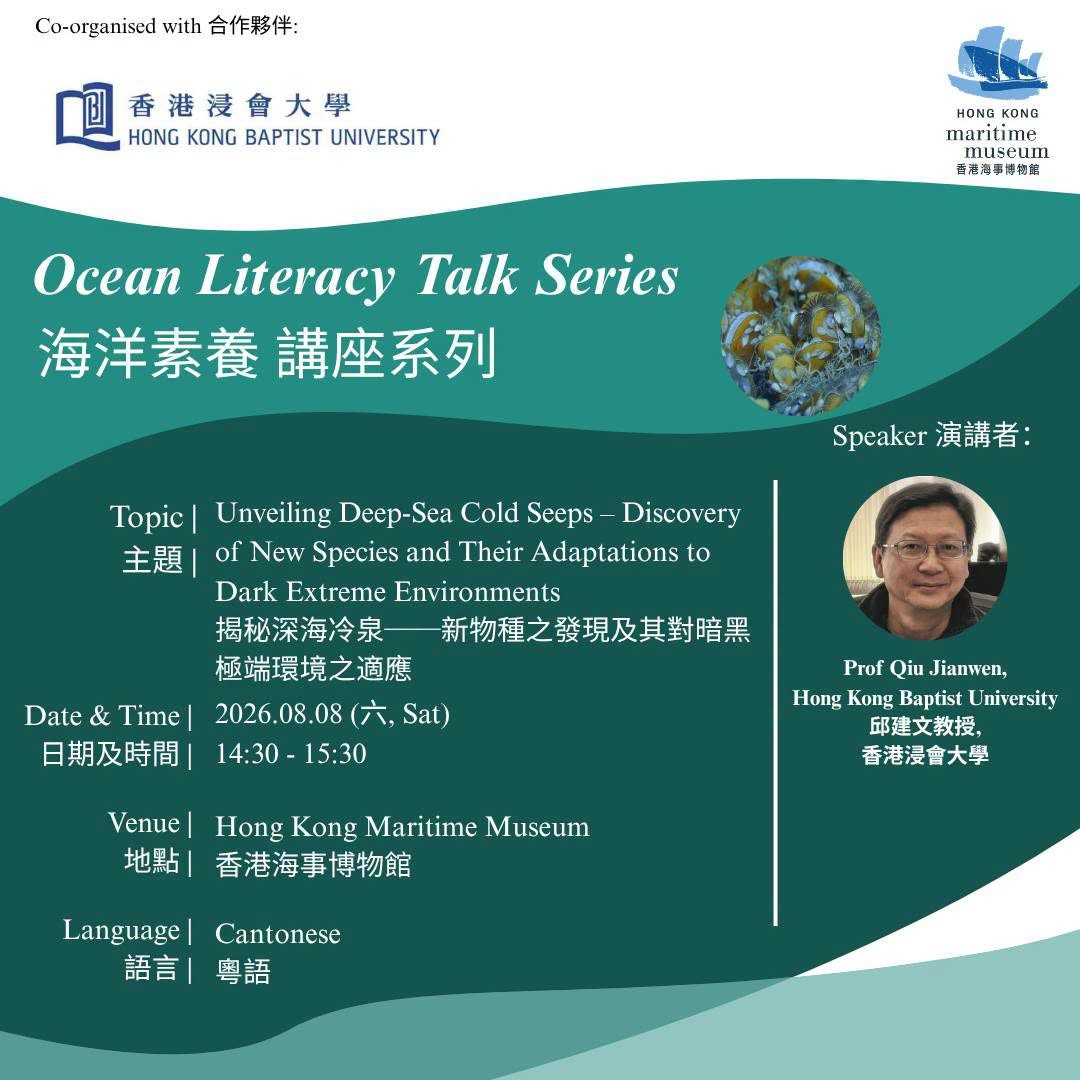
【 海洋素養講座系列 | 揭秘深海冷泉──新物種之發現及其對暗黑極端環境之適應 Ocean Literacy Talk Series | Unveiling Deep-Sea Cold Seeps – Discovery of New Species and Their Adaptations to Dark Extreme Environments 】
深海冷泉是海底富含碳氫化合物流體的滲漏區,廣泛分佈於水深200m至9,000m,不見陽光的海域。深海冷泉如深海中的「綠洲」,孕育出豐饒而獨特的化能合成生物群落,包括管狀蠕蟲、深海貽貝及冷水珊瑚等奇特深海物種,對於探究生命起源與極端環境適應性,深具重大科學價值。
本次講者,香港浸會大學的邱建文教授,在2013年參與中國自主研發的載人潛水艇「蛟龍號」的深海科研考察,是首位參與蛟龍號深海科研考察的香港科學家! 自2013年後,邱教授針對冷泉,這種不會接觸到陽光的生態系統,展開一系列生物學研究,旨在回答幾個問題:冷泉中存在哪些生物?牠們如何在這樣極端環境中繁衍?牠們從何而來,又將去何處?
本次講座將介紹南海冷泉生物的多樣性、種群聯通性,以及牠們對暗黑極端環境的適應機制。這些知識不僅有助我們了解冷泉生物多樣性,也能在人類深海活動,如可燃冰等海底能源的開發,日益頻繁的情況下,為這些特殊生物的保育提供參考。
Cold seeps, areas on the deep-sea floor where hydrocarbon-rich fluids seep out, are widely distributed across ocean depths ranging from 200 to 9,000 meters. Their ecosystems are akin to "oases" in the deep sea , nurturing abundant and unique chemosynthetic biological communities that include tube worms, deep-sea mussels, and cold-water corals. They hold significant scientific value for exploring the origins of life and the adaptability of organisms to extreme environments.
Professor Qiu Jianwen of the Hong Kong Baptist University became the first Hong Kong scientist to participate in a voyage of China's domestically developed manned deep-submersible vehicle "Jiaolong" in 2013. Since then, he has conducted a series of biological studies on cold seeps – ecosystems independent of light-driven energy – to answer several questions: What organisms exist in cold seeps? How can they thrive in such environments? Where do they come from, and where are they headed to?
This seminar will introduce the biodiversity, population connectivity, and adaptive mechanisms to dark extreme environments of cold-seep organisms in the South China Sea. The knowledge gained not only deepens our understanding of cold-seep biodiversity but also provides a baseline for the conservation of these unique organisms against the backdrop of increasingly frequent human activities, particularly the exploitation of submarine energy resources such as natural gas hydrate.
Date: 2026.08.08 (Sat)
Time: 14:30-15:30
Location:Hong Kong Maritime Museum, Central Pier 8
Language:Cantonese
Fee:Free of Charge
Sign up now: https://bit.ly/4f1kW6H