



Latent Human Cytomegalovirus Stops an Innate Immune Pathway at the Last Door
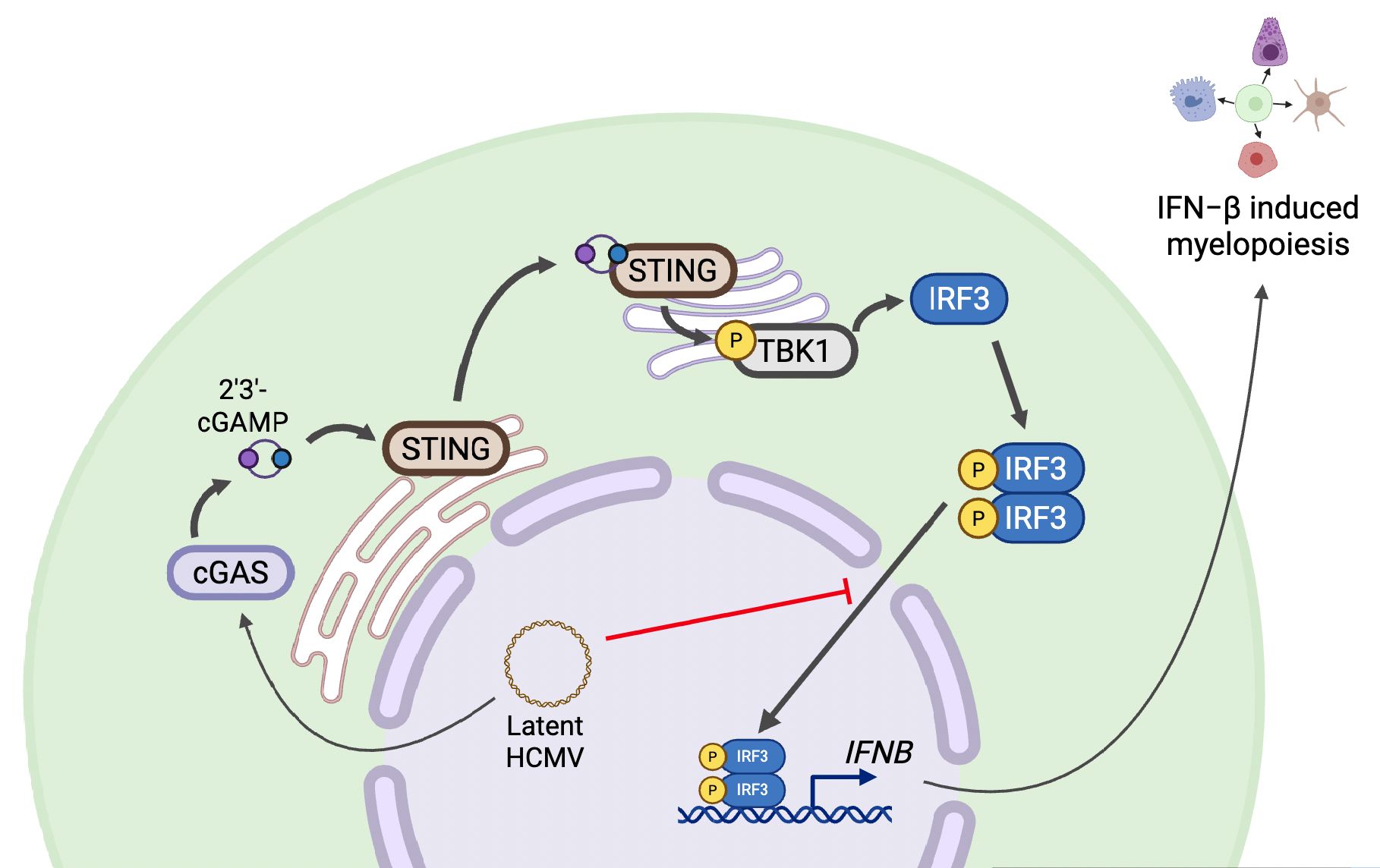
Latent human cytomegalovirus (HCMV) infection inhibits the cGAS-STING-TBK1-pIRF3 pathway by limiting pIRF3 translocation into the nucleus.
Human cytomegalovirus (HCMV) infects 60-90% of the human population, with no symptoms in healthy individuals because it goes into a dormant, or latent, state. To survive, the virus smartly hides in the CD34+ cells niche in the body, where the immune system is not able to remove the virus because these cells can repopulate, as well as differentiate into multiple types of immune cells.
Normally, the infected cells will try to fight against the virus by activating the STING/p-TBK1/p-IRF3 pathway to initiate innate immunity by producing a signal molecule called type I interferon (IFN-I). This is accomplished by the last baton holder, p-IRF3, where its activation allows moving into the nucleus and interacting with DNA to initiate IFN-I gene expression. The infected stem or progenitor cell also tries to differentiate into specialised cells that can respond to the virus more readily.
To explore more on the subject, Professor Allen CHEUNG from the Department of Biology, led a research team and found that HCMV performs a clever trick. During latent infection, the STING/p-TBK1/p-IRF3 pathway was activated, but the virus blocks the final step. The p-IRF3 protein is prevented from entering the nucleus, resulting in decreased type I IFN expression, and the cell does not differentiate. Instead, it reverts the infected cell to an earlier stem-like state, increasing its tenacity for survival.
The study provides insight into how HCMV regulates the infected cell during latency. Understanding how HCMV blocks p-IRF3 could lead to future treatments that overcome this viral control.
The research findings have been published in Viruses under the title “Latent Human Cytomegalovirus Infection Activates the STING Pathway but p-IRF3 Translocation Is Limited”.
https://www.sci.hkbu.edu.hk/research-spotlight/878?lang=en